RAAD Engineering Insights
RAAD Systems is evolving to meet a new generation of engineering challenges—from increasingly complex semiconductor equipment programs and multidisciplinary execution to expanded cleanroom capabilities and greater system-level support. Explore how our capabilities are growing today and where we’re headed next.
Edition 01 | October 2026
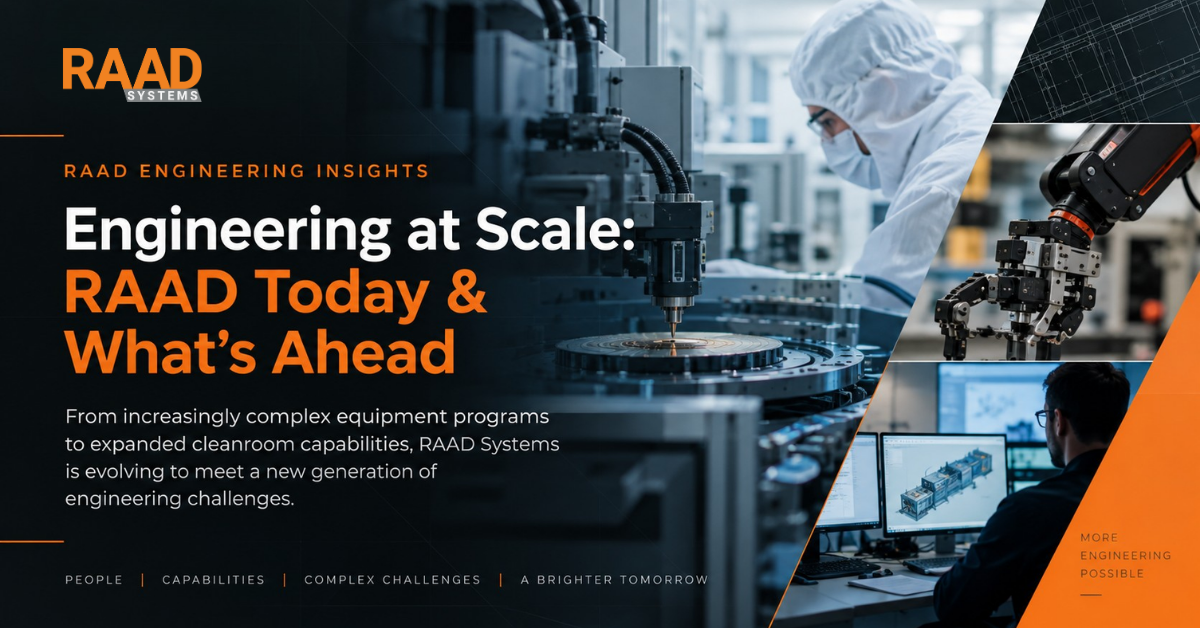
Engineering at Scale: RAAD Today & What’s Ahead
From increasingly complex equipment programs to expanded cleanroom capabilities, RAAD Systems is evolving to meet a new generation of engineering challenges.
Engineering is changing. So are we.
Over the past year, one of the most significant changes at RAAD Systems has been not simply the amount of work we are taking on, but the scale and complexity of that work.
RAAD has evolved beyond supporting individual engineering disciplines and isolated subsystems. Increasingly, our teams are contributing to complete equipment and system-level execution, bringing mechanical, electrical, controls, software, automation, manufacturing, integration, testing, documentation, supply chain and project execution together within increasingly complex programs.
This is particularly evident in semiconductor equipment, where multiple technologies and engineering disciplines must ultimately function not as individual components, but as one reliable machine.
At the same time, we have been strengthening what happens behind the engineering: project governance, manufacturing processes, quality systems, supplier management, documentation, configuration control and structured execution.
Together, these developments are expanding our ability to support customers across more of the journey—from an early concept through build, qualification and deployment.
“The biggest evolution has been the scale and complexity of the work we are taking on.”
Where We're Growing
Semiconductor equipment, automation and complete product realization
One of RAAD's strongest areas of growth continues to be semiconductor equipment engineering and automation.
Our capabilities are expanding across precision mechanical systems, motion control, robotics, electrical and controls engineering, machine software, vision systems, process automation, equipment integration and complex manufacturing.
But perhaps more significant than growth within any one discipline is the evolution of how those capabilities come together.
Customers are increasingly looking beyond standalone engineering packages. They need partners capable of helping source, manufacture, integrate, test and document a system—and ultimately help bring it into production.
For RAAD, the combination of engineering expertise and execution capability is becoming an increasingly important part of the value we provide.
What We're Hearing From Customers
The engineering problem is becoming a system problem
Many of the challenges customers bring to RAAD today are no longer straightforward component-design problems.
They are system-level challenges.
A program may need to bring together precision motion, robotics, controls, software, sensors, safety systems, vacuum or process interfaces and mechanical structures—all while meeting demanding requirements around space, accuracy, cleanliness, reliability and serviceability.
Another recurring challenge is the transition from a concept or partially developed design into something that is genuinely manufacturable, serviceable, repeatable and production-ready.
That is changing the question customers ask of their engineering partners.
“Increasingly, the question is not simply, ‘Can you design this?’ It is, ‘Can you help us turn this into a reliable machine?’”
And expectations around that relationship are changing too.
Customers increasingly want fewer handoffs. They expect an engineering partner to understand not only design, but also cost, sourcing, manufacturability, schedule, quality, documentation, integration, testing and lifecycle considerations.
Speed and adaptability have become equally important as programs evolve rapidly. At the same time, customers expect greater transparency into risks, schedules, costs, technical decisions and supply-chain constraints.
The challenge is therefore not simply moving faster.
It is moving faster without sacrificing engineering discipline.
Where Multidisciplinary Engineering Creates Value
One of RAAD's greatest strengths may also be one of the least visible from outside the organization: our ability to bring multiple engineering disciplines together and remain involved through execution.
A mechanical problem may require a change in electrical architecture.
An automation requirement may affect mechanical tolerances.
A manufacturing decision may affect serviceability.
An electrical decision may create downstream software implications.
Treating each discipline independently can allow these dependencies to remain hidden until integration—precisely when they become more difficult and expensive to resolve.
“The greatest value appears at the interfaces between disciplines.”
Because RAAD works across mechanical, electrical, automation, software, manufacturing and system integration, these interactions can be considered earlier in development.
The potential result is fewer iterations, faster debugging, better manufacturability and a shorter path to production.
This approach is particularly valuable for the highly customized, relatively low-volume and technically complex equipment RAAD frequently supports—programs where every machine can contain substantial engineering content and unexpected integration challenges are part of delivering the finished system.
Engineering in Practice
When dozens of complex systems have to become one
A recent type of program that illustrates this work is the development and integration of a multi-module automated semiconductor equipment platform.
Without sharing customer-specific details, a system of this nature can involve robotic wafer or material handling, precision motion assemblies, inspection systems, electrical and controls architecture, machine software, safety systems, multiple process or handling stations, and extensive mechanical and electrical integration.
Individually, each subsystem presents an engineering challenge.
Together, they present a very different one.
“The real engineering challenge is making dozens of independently complex subsystems behave as one reliable production machine.”
Programs like these represent an area in which RAAD intends to continue growing: complex equipment where multidisciplinary engineering, manufacturing, integration and problem-solving come together to create value.
What We're Learning
Engineering discipline matters more as complexity increases
Growth brings lessons with it.
One of the strongest from this year has been the importance of early alignment and disciplined change management.
In a complex equipment program, what appears to be a relatively small engineering change can create downstream effects across procurement, manufacturing, software, documentation and schedule.
Our teams have therefore become increasingly focused on clearly establishing requirements, freezing interfaces where possible, strengthening configuration control, identifying long-lead components earlier and making the broader impact of engineering changes visible before implementation.
There is another lesson that is deceptively simple:
“Communication is itself an engineering tool.”
When customers, suppliers, engineers, manufacturing teams and project managers align early, many technical problems become easier to identify—and easier to solve.
Building the Infrastructure Behind the Engineering
Expanding our cleanroom capabilities
Our engineering capabilities aren't the only part of RAAD that is evolving.
We are also investing in the physical infrastructure required to support larger and more sophisticated programs, including Class 10,000 and Class 1,000 cleanroom capabilities.
This expansion allows RAAD to move beyond engineering and conventional manufacturing into controlled assembly, integration, inspection and testing of contamination-sensitive equipment and subsystems, particularly for semiconductor applications.
But the larger story is scalability.
As the complexity and size of our programs increase, we need infrastructure capable of supporting multiple equipment builds, integration activities and customer programs in parallel.
Our longer-term objective is to bring more of the product-realization cycle together within one organization:
MECHANICAL + ELECTRICAL + SOFTWARE ENGINEERING
↓
SOURCING + MANUFACTURING
↓
CLEANROOM ASSEMBLY
↓
SYSTEM INTEGRATION
↓
TESTING + QUALIFICATION
For customers, particularly global semiconductor equipment companies expanding their engineering and manufacturing ecosystem in India, this creates the opportunity for a more connected model of execution.
Looking Ahead: Q4 and the Semiconductor Opportunity
As we move into Q4, semiconductor equipment remains one of the areas we're most excited about.
India is developing a broader semiconductor ecosystem, creating opportunities not only around fabrication itself, but throughout the equipment, automation, subsystem, engineering and supply-chain ecosystem that supports it.
For RAAD, we see particularly strong opportunities across:
Semiconductor Automation • Precision Equipment • Robotics • Inspection • Material Handling • Process-Equipment Subsystems • NPI Builds
We're also interested in building deeper partnerships with global technology and equipment companies where RAAD can operate as an extended engineering and manufacturing organization, rather than simply a conventional supplier.
Looking Toward 2027
Moving higher in the engineering value chain
Our direction for 2027 builds naturally on this evolution.
The opportunity we see is to continue moving from engineering individual components and assemblies toward participating in complete subsystem and equipment-development programs.
Semiconductor equipment will remain an important area of focus, while the multidisciplinary capabilities behind that work also have applications across advanced manufacturing, automation, robotics, medical equipment, inspection systems and other precision-engineering industries.
We also see significant potential in helping global companies establish engineering and manufacturing capacity in India—creating a bridge between global product engineering and India's growing engineering, supply-chain, manufacturing and integration ecosystem.
Longer term, there is another important opportunity ahead: developing more of RAAD's own intellectual property, standardized platforms and reusable engineering architectures.
It is an ambitious direction, but one grounded in the capabilities we are building today.
More Than a Vendor. An Engineering Partner.
As RAAD grows, one principle remains central to how we want to work with our customers.
“RAAD does not see itself merely as a vendor executing drawings or specifications—we want to understand the engineering problem and take ownership of helping solve it.”
Our strongest engagements are those where customers bring us in early, share both the technical objective and the constraints surrounding it, and allow multidisciplinary teams to contribute to the solution.
Whether the requirement involves engineering, automation, software, manufacturing, integration or bringing a complex machine from concept to production, our objective remains the same:
To become an extension of our customer's engineering organization and help turn difficult ideas into working equipment.
That's where RAAD is today—and where we're building from as we move toward 2027.
Design. Build. Deploy.
— RAAD Systems